
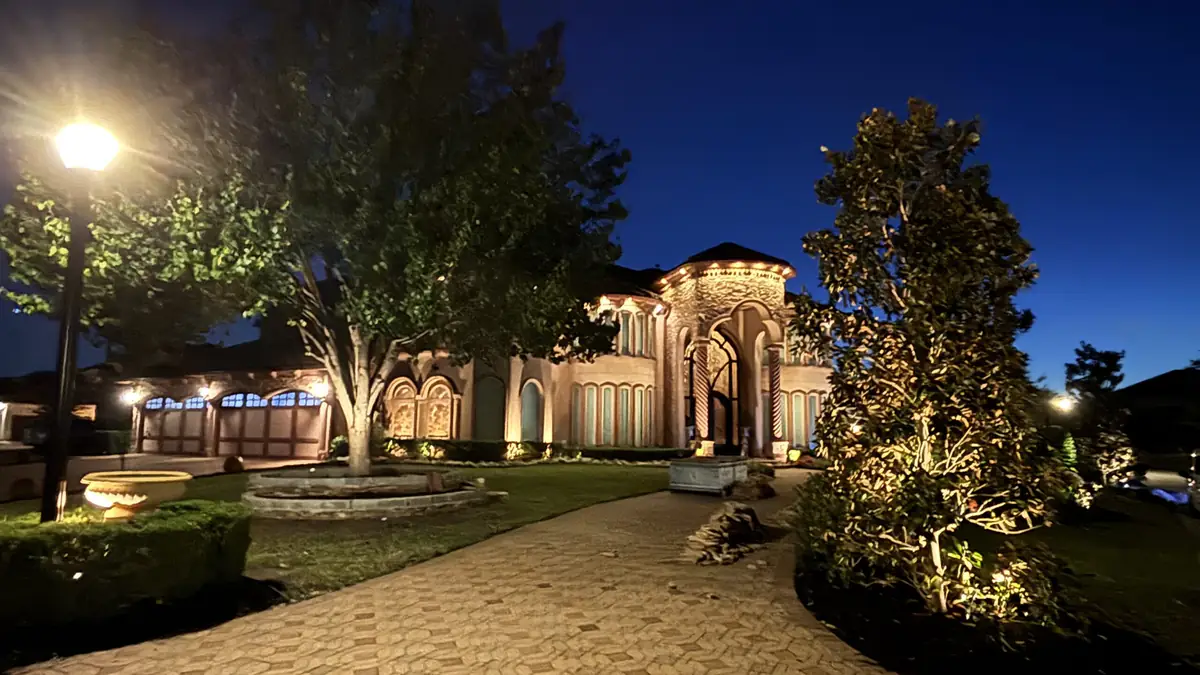
What Kelvin actually measures. Colour temperature describes how warm or cool a light source appears. Lower numbers are warmer and more amber; higher numbers are cooler and bluer. Candlelight sits around 1900K, a traditional incandescent bulb around 2700K, and midday daylight around 5500K.
2700K is the residential answer. It matches what people associate with a lit home — warm, inviting, flattering to brick, stone, timber and skin. It is the temperature we specify on essentially every residential system we install in Houston.
3000K has a narrow use. Slightly cooler and a little crisper on very light modern stone, white render or contemporary architecture. On traditional brick it starts to look clinical. We use it occasionally, deliberately, and never mixed into a 2700K scheme.
4000K and above is a mistake in a garden. It reads as commercial, unflattering and strangely cold — the colour of a car park rather than a home. It also makes foliage look grey rather than green. If a quote specifies 4000K for a residential landscape, it is a sign the fixtures were chosen on price.
Foliage is the exception worth knowing. Some designers push slightly cooler light into dense green canopy because it renders leaves more vividly. It is a legitimate technique, but it needs deliberate zoning so the cooler fixtures never sit in the same sightline as warm light on the house. Done carelessly it just looks like a mismatch.
Consistency matters more than the number. A whole garden at 3000K looks intentional. A garden at 2700K with three 3000K fixtures in it looks broken, and the eye picks it out immediately. This is the most common problem we find when somebody has replaced failed lamps themselves with whatever the hardware store had.
Ask for the colour temperature in writing on any quote. If it is not specified, it will be whatever was cheapest that week.
Kelvin compared
Colour temperature compared
| Colour temperature | Appearance | Suits | Verdict for Houston homes |
|---|---|---|---|
| 2400–2700K | Warm, slightly amber | Brick, stone, timber, traditional architecture | Default. What we specify on essentially every job. |
| 3000K | Neutral-warm, crisper | White render, pale contemporary stone | Occasionally, and only deliberately. Never mixed into a 2700K scheme. |
| 3500K | Noticeably cool | Little residential use | Avoid. Falls between two stools. |
| 4000K and above | Cool, blue-white | Commercial and security lighting | Avoid on a home. Foliage reads grey and the house reads like a car park. |
Consistency matters more than the exact number. A whole garden at 3000K looks intentional; a 2700K garden with three 3000K fixtures in it looks broken.
In short
2700K
The default for residential. Warm, flattering to brick and stone, matches how a lit home should read.
3000K
Occasionally right on white render or very contemporary stone. Never mixed into a 2700K scheme.
4000K+
Commercial and cold. Makes foliage grey and a house look like a car park.
Foliage zoning
Cooler light in dense canopy is a real technique — but only if zoned out of the warm sightlines.
Consistency wins
One mismatched lamp is more noticeable than the wrong temperature applied evenly.
Get it in writing
If Kelvin is not on the quote, it will be whatever the supplier had cheapest.
Answers
Related questions
Is 2700K or 3000K better for landscape lighting?
2700K for almost all residential work — it is warmer and far more flattering to brick and stone. 3000K suits some very modern, light-coloured architecture.
Why do my landscape lights look blue?
Either the lamps are a high colour temperature, or they are cheap units whose colour has drifted with age. Replacing them with matched 2700K lamps is usually a straightforward fix.
Can I mix colour temperatures?
Only deliberately and with proper zoning, such as slightly cooler light used within dense foliage. Mixed temperatures in one sightline always read as a mistake.
Free, no obligation
Still have a question?
Call and ask — we would rather talk you out of the wrong system than sell you one.
- (832) 303-0428
- ambianceoutdoorlights@gmail.com
- Houston, Texas