
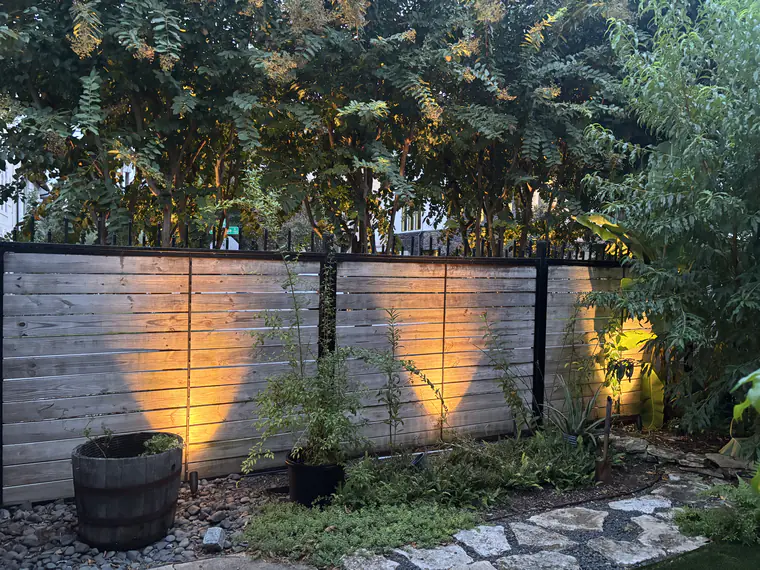
The short answer. A low-voltage system has three parts: a transformer that converts 120V mains to 12V, buried cable carrying that 12V around the garden, and fixtures that plug into it. Almost every quality residential landscape lighting system in Houston is built this way.
Why not just use mains voltage? Because 120V buried in a flower bed is a genuine hazard. Anyone digging a planting hole, an irrigation contractor trenching a new zone, or a child with a trowel is one spade away from a serious injury. At 12 volts, cutting the cable is a nuisance rather than an emergency. Line voltage also requires conduit, permits and an electrician for every future change.
Is low voltage dimmer? No, and this is the most common misunderstanding. Brightness comes from the lamp, not the supply. A 12V 5W LED and a 120V 5W LED produce the same light. Low voltage buys safety, cheaper cable and easy expansion — it costs you nothing in output.
Where low-voltage systems go wrong. Low voltage means high current, and high current loses voltage over distance. Run 12V down a long, thin cable and the fixtures at the far end receive 10V or less. They go dim and visibly yellow, and the LED drivers fail years early. This is the single most common fault we find on systems installed by somebody else, and it is entirely a design failure — the load on each run has to be calculated and the wire gauge sized to match.
What good looks like. A correctly built system uses a toroidal transformer in a stainless enclosure with at least 20% spare capacity, 12/2 cable as a minimum and 10/2 on long runs, sealed waterproof connectors rather than push-on twist caps, and solid cast brass fixtures that will not corrode through in Gulf Coast humidity. Voltage is then measured at the last fixture on every run with the system live, and the transformer tap adjusted until it is inside spec.
If you are weighing up a quote, ask the installer what wire gauge they are running and what the measured voltage will be at the last fixture. A good answer tells you a great deal. See our low-voltage landscape lighting page for how we size and install these systems.
In short
12 volts, not 120
A transformer steps mains down before anything goes in the ground. Safe to dig near, safe to cut.
Same brightness
Output comes from the lamp. A 5W LED is a 5W LED at either voltage.
Easy to extend
No conduit, no permit, no electrician to add a fixture later — provided the transformer was sized with headroom.
Voltage drop is the risk
Long or undersized cable starves the far fixtures. Load per run must be calculated, not guessed.
Brass over aluminium
Cast brass patinas. Stamped aluminium corrodes through on the Gulf Coast, usually around year four.
Measured, not assumed
A proper installer measures voltage at the last fixture on each run and adjusts the tap.
Answers
Related questions
Is low-voltage landscape lighting safe?
Yes — that is its main advantage. Everything buried in the garden carries 12 volts, so cutting a cable with a spade is an inconvenience rather than a serious risk.
Do I need an electrician to install it?
Not for the low-voltage side. The transformer plugs into an existing exterior GFCI outlet. Only if your property lacks a suitable outlet does an electrician need to add that one circuit.
How far can a low-voltage run go?
With correctly gauged cable, well over 200 feet. The limit is voltage drop, not distance — we step up to 10/2 wire or add a second transformer closer to the far zone on large properties.
Can I add fixtures to an existing low-voltage system?
Usually yes, if the transformer has spare capacity and the cable is adequately sized. We check both before quoting an extension.
Free, no obligation
Still have a question?
Call and ask — we would rather talk you out of the wrong system than sell you one.
- (832) 303-0428
- ambianceoutdoorlights@gmail.com
- Houston, Texas